
I’ve been writing here for a while now. Back when it was called Dual Squirrels—though the name had to change when one ate the other. In my time here, I’ve written more previews than reviews. It only makes sense that eventually I’d circle back and do follow-ups to some of those previews, numerous as they are. And so it happens again! This one is the quickest turnaround so far. I previewed this game at PAX East earlier this year, and my first article dropped on May 22nd. So, in today’s edition of FOLLOWING UP ON MY RECOMMENDATIONS we’re talking about the arcade puzzle game Strings Theory, developed and published by BeautifulBee. The initial release date was way back in December 2021, but it saw a console release on the same day I first played it—early May of this year. It’s available on all the platforms you’d expect: Switch, PS4 & 5, and the Xbox family. Back when I played Strings Theory at PAX, I only had a short window to dedicate to it. Other people wanted their turn, and there were plenty of other games pulling my attention. But now I have the full game, and I can play it at my leisure from the comfort of home. So, how does it hold up?
Strings Theory is a level-based puzzle game where you control one of three Strings: Telly, Isaac, and the twins, Norm & Sal. There are over fifty levels of increasing difficulty, each with its own challenges and a light narrative to carry everything along. Every level holds a set number of quarks you’ll need to collect in order to progress. Like I said in my preview, simplicity is the key here. That simplicity runs through everything, from the controls to the gameplay to the presentation, except, of course, the puzzles themselves. But that’s not a weakness; it’s a deliberate design choice that makes the game accessible, almost in the way mobile puzzlers tend to be. At its core, Strings Theory feels like a game that could’ve existed on the SNES. Aside from introducing new hazards along the way, you’ll have a solid idea of what kind of experience you’re in for after just a few levels. With the broad strokes in place, let’s talk about execution, starting where I always do.
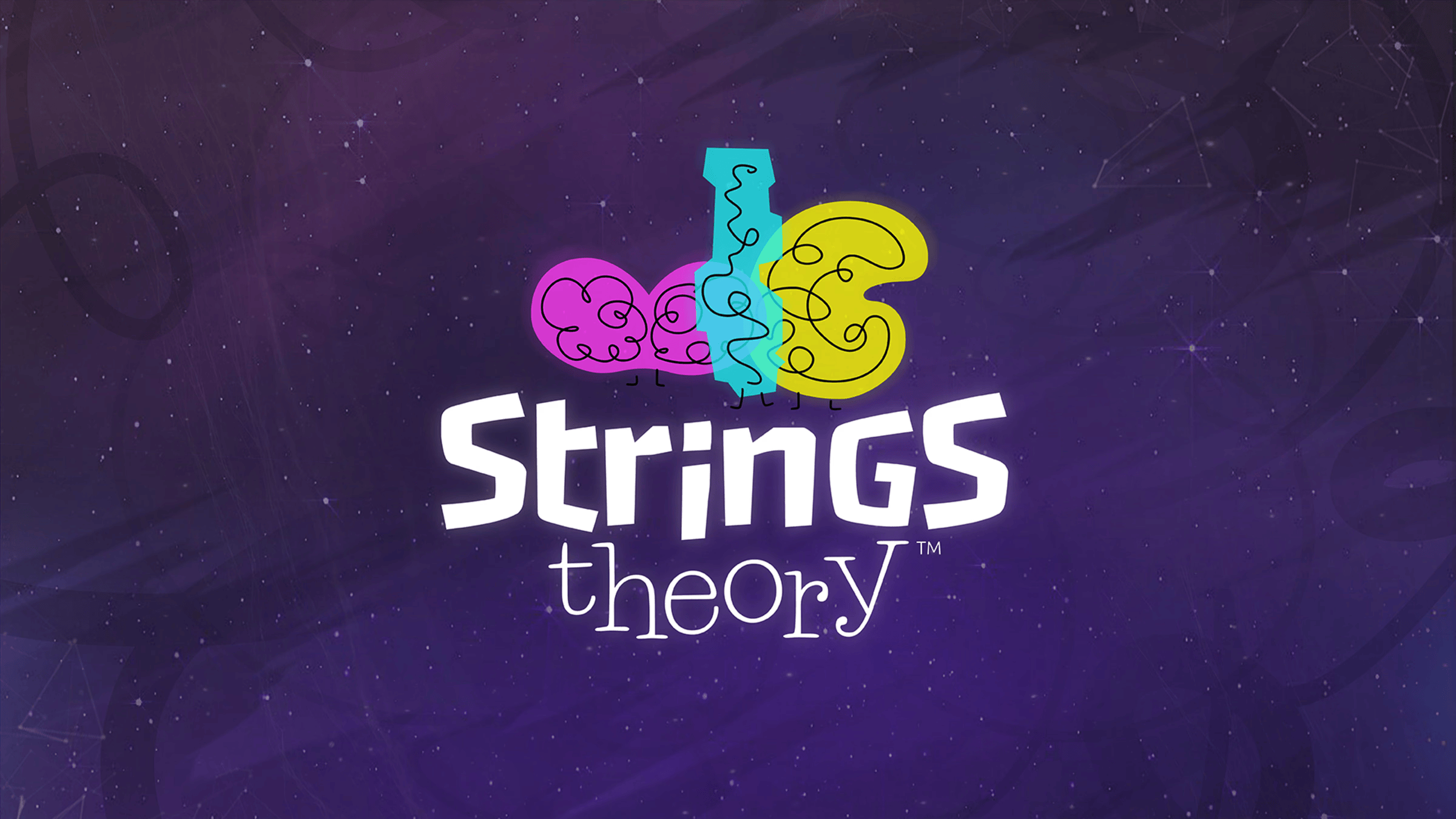
The presentation leans into simplicity. The color scheme relies on soft glows and gentle shades. Backgrounds are a midnight blue with constellations drifting by. The Strings themselves are squiggly lines with unique shapes and colors: Telly is blue and upright; Isaac is yellow and “C”-shaped; and the twins, Norm & Sal, are pinkish-purple and, well… look like testicles, especially when joined together. Even when separate, they still lean into that “ball-ish” territory. The quarks you’re collecting are squiggly circles with gray borders, like little cartoon dustballs. The levels themselves are grid based and viewed at an isometric angle. Strings can move in one of four directions if there’s an available grid. Most of the grids are white, and can be walked on by any String that can actually reach them. Some of the grids are grayed out, and can only be traversed under a specific condition. There are different types of moving panels you’ll encounter, but we’ll get into those in a bit. The path across each level to collect the quarks isn’t always straightforward, and discovering the path is the puzzle you need to solve. Everything you can interact with clearly stands out from the rest of the game board.
The controls won’t take long to get used to. You can move your Strings in one of four directions, there’s an “Interact” button, a button that allows you to shift the angle of your isometric view, and the shoulder buttons will swap between any Strings available in that particular level. Occasionally you’ll come across floor panels that any of the Strings can use to teleport to a different part of the level, activated by the Interact button. But mostly that button is used for the Strings’ unique abilities. Anytime a String can utilize their abilities, they glow their respective colors. Telly can knock over walls, turning them traversable panels; Isaac can phase through certain floor panels, allowing him to walk over the grayed out panels that the others can’t walk on; and the Twins can split in two to tackle the puzzles as a pair using quantum entanglement. Which is a statement that probably doesn’t make a lot of sense on the surface. I’ll explain.
I mentioned moving platforms earlier. This game has a whole plethora of moving platforms. Some of them move in clusters and are controlled by you. Step on a glowing ground panel and they move on a track. Other panels move on their own, and some only move when you step on them. The last kind of panel I mentioned is where the aforementioned quantum entanglement comes into play. Any of the Strings can step on those panels, their trajectory is determined by the direction you step on it. At which point they move back and forth on a track, bouncing between obstacles that stop it from continuing in that given direction. The Twins have more control over these panels because of the attraction they have to each other. They can walk together as one unit, taking up a single panel, or they can split up and walk around individually as Norm and Sal. If one is on the moving panel, and the other is standing on a panel to either side of the path, they will glow when they pass each other. Pressing Interact will cause the one on the moving panel to magnetically attract to the other, which will cause the panel to move on a perpendicular track, allowing access to areas that Telly and Isaac can’t get to on their own.
In order to solve each puzzle, you’ll need to combine all the above mentioned mechanics to make your way across the game board, collecting the required amount of quarks, and getting all the available Strings to the exit. Some of the levels require you to collect every quark, but mostly you only need to get most of them to open the exit. Collecting all of the quarks in those levels will be a lot harder. The late game puzzles get hard on their own, so the challenge behind the bonus quarks is next level. There’s 53 levels and 7 bonus levels, and this is the formula for the entire game. With some exceptions. There’s a story to Strings Theory, telling why the Strings are working together in the first place. They are making their way to the center of an Anomaly to prevent a Stagnation from destroying their subatomic world. Because of this, some of the levels are designed to aid that story. Including two late game levels that are essentially boss fights. As much as the established formula can allow. And they’re fun. It makes me wish that they did that sooner. It’s too bad you need to get through so much of the game before you see something like that.
As it stands, it makes the game lack variety at a point when it really could’ve used some. Like I said, simplicity is key to Strings Theory, but that doesn’t always work in the game’s advantage. The bonus levels are fun and not too challenging, but aren’t different enough from the main levels to help the samey-ness that pervades the whole game. That’s not to say this is a bad game. This is perfect if you want a pick up and play game that can kill a few minutes. As mentioned, the puzzles get really hard. Actually making your way to the final level is an accomplishment, and even once you beat the game you can go back and collect any quarks you may have missed along the way. You just may not wanna do it all in one go. Final thoughts on this is it’s a Bin It. Don’t pass this one by, but maybe wait until a sale to pick it up.