

Sometimes you wanna take a break from all the overall-laden platforming, demon slaying, and first person shooting. But what are you gonna do? Go outside and get another hobby? Naw, too much effort. Why not shift gears to a game that’s a little more relaxing? Cozy, even.
From the land of Rammstein and Oktoberfest comes a cozy little crafting/survival game called Solar Punk. Developed by two-person team Cyberwave, this game has you sailing the skies from one floating island to the next. In Solar Punk you’ll find an amalgamation of features both functional and not, with mechanics that can somehow be deep and lacking. It’s like a bruised apple. The gameplay loop is the sweet, juicy mass of the fruit that’s layered by a skin dotted in blemishes that spoils a little bit of what’s underneath.
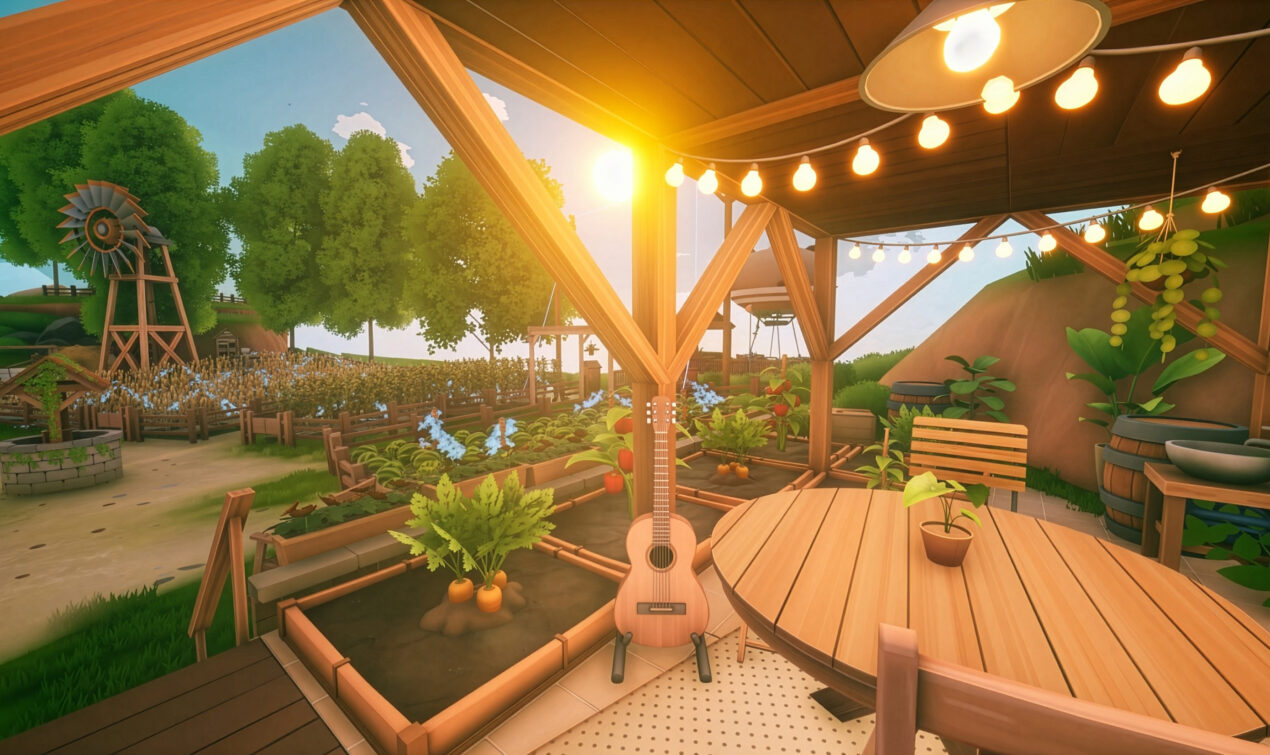
If you ask me, what makes a cozy game cozy is found in more than just the 1’s and 0’s contained within the programming. It’s in your actual real life experience, in front of your TV or monitor, playing the game. The definition of a cozy game can be a bit of a Venn diagram: there’s your definition, mine, and then the shared traits we can all agree on. For me something like diminished or absent combat is only a part of that equation. I like games that can be temporarily set-it-and-forget-it. This includes any gameplay system that takes the passing of real world time to complete, such as farming or traversing a large expanse of the map via some means of conveyance that only requires the occasional operational input. If I can put down the controller at any point in a game to put on some background noise or partake in getting inebriated without the usual worries of going AFK, that’s a massive plus for me. I’ll be looking at this game from both standards: how it stacks up as a cozy game and as a crafting/survival title.
Visually, the aesthetic identity of Solar Punk is bright and colorful. This cartoony presentation leans into the the overall package for a world that is mostly inviting. Your starting island resembles a lush, temperate region. Green grass, healthy trees, Chickens. All things to make you feel right at home. The nighttime’s soothing glow keeps even the later hours from being dreary. That’s saved for the rain storms when you can’t see that far ahead of you until then suddenly an abundance of electricity gathers near you and BOOM! Lighting strike. The game is visually at its strongest when you’re soaring through the skies on your airship. Distant islands are silhouettes in the haze that take form upon approach. There’s a tremendous sense of distance and scale created in your excursions. Everything can feel so far away until they suddenly aren’t and you’ve arrived at your destination. If you fly low enough, you’ll be able to fly through the clouds that the islands float among. The visual effect of being enveloped in them is really impressive. The outside world just disappears, replaced by a veil of cloudy white and blue. First time I did it was totally a mistake, so of course I circled back around to see it again.
That cozy theme invades the soundtrack of Solar Punk with gusto. The music consists of soft melodies that are meant to blend into the background. More prominent will be the sounds of chopping wood, the pattering rain, the gusting winds, and the striking lightning. Perfect for those of us who like to put something else on for background noise when relaxing with a game, be it music or whatever pops up on my YouTube feed. That’s one of those things that can help me get lost in the gameplay loop and before I know it, hours have gone by.
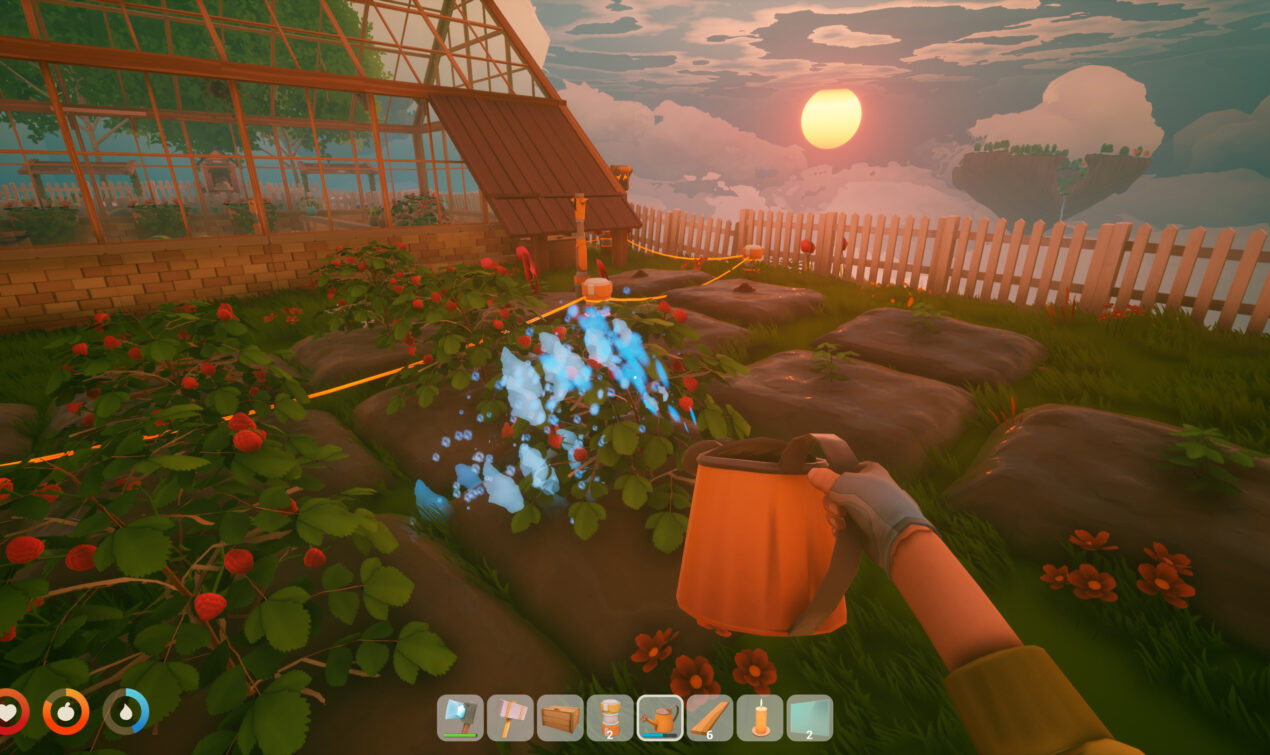
The gameplay, however, is where rapids begin invading our leisurely drift down this stream. For the most part Solar Punk’s mechanics work. Some hiccups do persist, but they won’t break the flow of the game if you know what you’re doing and have a bit of patience. It begins with the tutorial. You’ll get a short series of instructions like building a basic axe then cutting down a tree. At no point will the tutorial tell you what buttons do what in your quest to fulfill such weighty tasks, that’s up to you to figure out. Whether you take the time to read the options menu or pull the wing-it method of pressing every button until you figure out their function is entirely your choice. Luckily Solar Punk subscribes to the same general control scheme of your average survival/crafting game, so the latter method will suffice for veterans. Instead of teaching the controls, the tutorial is meant to familiarize you with how the crafting and material-gathering mechanics in this specific game operate. Like when you chop down a tree, your job is done. There’s no going up to the downed tree to further harvest it for wood. Tree falls, makes a sound, ‘cause you’re there, and then poofs away adding all the materials the game offers for such a task. After the tutorial you’ll be well established to get yourself to the mid and late game content. It’s at this point where a veteran’s familiarity actually starts being a detriment.
Exploring the islands requires you to have your home base in order, as comes with the territory. You’ll want some food and water ready for when those stats start getting low. Some extra materials for any repairs that made need to happen, or any new items you can make thanks to your expeditions. Establishing said base requires some effort. You have to mine, farm and scavenge to get to that point, all the while consuming the very resources you’re trying to build. More to my point, you’ll be in and out of various inventories. More so in this game than most other crafting/survival games because you’ll quickly notice that Solar Punk does not let you build with materials that you have in storage, as its brethren are oft to do. You need everything in your pockets which is annoying in any circumstance, but especially so when you’re trying to build some of the game’s larger projects. The next thing you’ll notice is how unintuitive moving items from one inventory to another is. There’s an on screen button that allows you to mass move anything from your pockets into a storage box where that particular item is already represented, but the stacks will not overlap. If you’re like me and item organization is paramount to the experience, you’ll be allocating a lot of time towards keeping things in some kind of order. Hopefully we see some of this corrected in any future with some quality of life updates, just to smooth out the experience a tad.
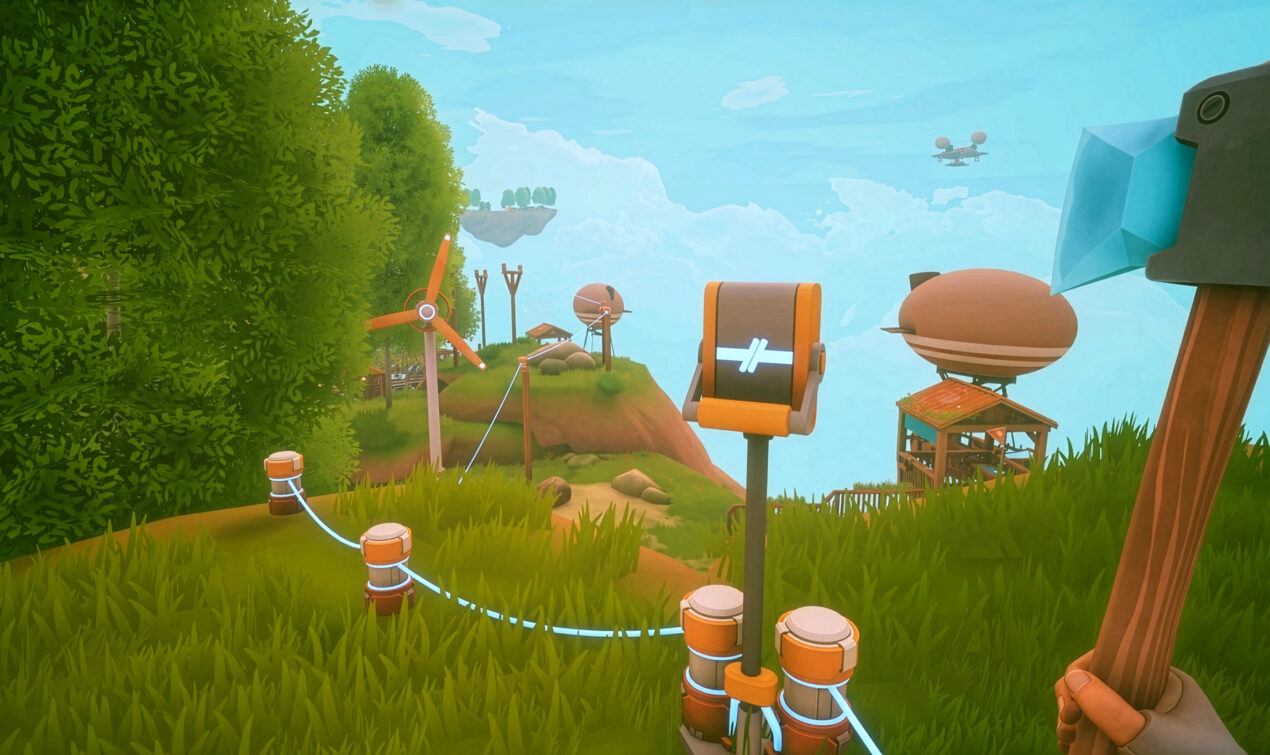
How you go about getting your home up and running is one of the highlights of the game. You need to utilize the power of nature to run your home. In the early game this will pretty much only take the form of solar panels and generators. The latter is good in a pinch when you’re getting set up, but you’ll quickly find that they are resource intensive for such a small amount of output. Solar panels are much better at generating power, but of course they have their limitations that can be compensated with batteries that can store extra energy during the day. Come night or a rainy day, you’ll still have some juice in reserves for those occasions. Speaking of rain, hydro power is the next best option. It rains a lot, and you can swap between your home running on one or the other with the flip of a switch. Wind power was my go-to once I was able to craft the items necessary. Which almost makes too much sense. You live on islands that float above the clouds, there’s going to be some turbulent winds. Day or night, rain or shine, the wind is gonna blow, and you’ll easily get the best power output from them. With all that established, you can comfortably get on your airship and begin seeing the other areas the game has to offer.
You actually gain access to the airship near the end of the tutorial. Within the first hour of gameplay you’ll have found the schematics and will be ready to Lindbergh yourself to new lands. When you first pilot it, the engine is only so powerful. Looking at the map shows you what islands are accessible at any given time. The whole map is revealed to you as soon as you gain access to it. There is no fog-of-war in Solar Punk. The area you’re limited to traversing within is clumsily marked off with a white circle slapped on the map screen. Anything inside the circle is a-okay for you to reach. One of the first islands you can reach is more of a floating platform with a robot merchant residing on it. If Solar Punk had a story campaign, which I would say is a definitive maybe, this guy would be key to progressing through it. You see, in lieu of anything usually resembling a campaign is just a game-long trade quest. That robo-merchant, who happens to be the game’s sole NPC, is who you’ll be trading the myriad of items to. In exchange you’re mostly rewarded with blueprints that allow you to build more complex infrastructure for a more efficient base. Sprinkled among the blueprints are a series of ship upgrades, each of which expands the diameter of that white circle on your map.
With each widening of that stylish and not at all tacked on white circle, a new batch of islands becomes available to you. Naturally this comes with new stuff to find. Copper for stronger metals, quartz and cobalt that can be used in mechanical devices, as well as new livestock and crops. All of which are crucial to the trade quest. Now, reading all that, one would think that the subsequent islands will have different biomes. A change of scenery to give you something new and exciting to see, but alas. That lush, green temperate region that greets you when you load up a new file is what is waiting for you on all but the last set of islands. Even when you reach the final islands and inevitably complete the trade quest, there’s no fanfare of any kind. No “congrats you did it, you should keep going” message or anything. Kind of reminds me of real life. No pat on the back at the end of the road, just business as usual. See you on Monday, the cycle continues.
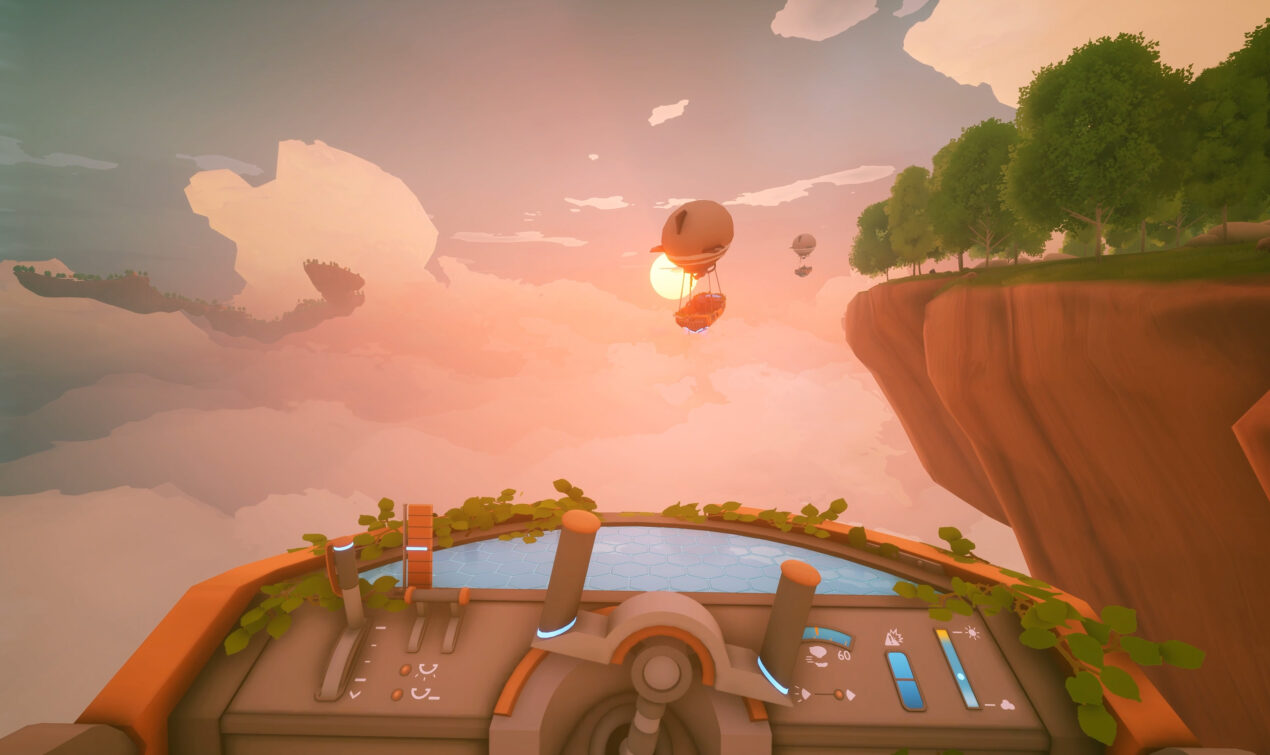
On a parallel subject, none of the ship upgrades will change its look. The one you get at hour one will be the one you’ll have at roughly hour fifty when you’ve reached the final islands. I know a small team made this, but the idea of giving the player some kind of visual indication that they’re progressing through a game has been around since I was a little kid and I ain’t no spring chicken anymore.
The game isn’t all bad, though. Like I said, with the patience to overcome the lesser aspects, you can find yourself in a very addictive gameplay loop with mechanics that are easy to get the hang of. All the burgeoning technologies that you’ll unlock along the way may seem daunting when you see the number of options available to you, but simply rolling up your sleeves and digging into them is the best way to learn them. You’ll quickly find that they all work intuitively. Figuring how much power things like your sprinkler system or mining drills or drone helpers need takes some trial and error. Once you learn that, delegating the power is a breeze. Sometimes literally. You can get to a point where the actual human involvement is reduced to a few key chokepoints in the process. If the process hasn’t reached those points yet, then there might be some waiting around. For me, this is the perfect time to set the controller down, watch all my operations chug along, and allow some of my aforementioned IRL activities to take my attention temporarily. Another time you can potentially put the controller down, albeit much more cautiously, is mid flight. The early to mid game islands are fairly close by and can be reached relatively quickly, so this isn’t really for that. I’m more referring to the islands you can access with the last couple of upgrades. It’s the journey to those islands where you really get some time on your hands. Beyond my own habits, the long flights calls to attentions how limited you truly are when in transit. There’s no way to check your inventory, considering the genre that seems like an important thing. More puzzling than that is the severe lack of storage in the airship. Did your pockets fill up during an expedition to a new island? Well, too effing bad. Saddle up for all the back and forth traveling something like this will result in.
So yeah, Solar Punk is a mixed bag. An amalgamation of features both functional and not, with mechanics that can somehow be deep and but disappointingly lacking. I had fun with this, and a lot of that may come from the fact that I don’t play a lot of games like this. I can probably count on one hand the number of them I’ve played, never mind the ones I actually spent significant time in. That being said, even I can see that this game is so close to being a proper classic. Yet I can’t in good conscience say to pass this one by completely. If you have an Xbox and subscribe to Game Pass, then you’re golden. Go ahead and kick the tires. But if you want to play it on Playstation, Nintendo, or Steam, there’s a $22.99-sized elephant in the room to consider. Even with that low price, my final verdict on this game has to be Bin It. I’m really hoping this game sees some more love in future updates. The foundations for a new cozy classic are there, it’s just a few glaring issues that hold it back from cementing itself in that status. At this point in a review it’s common for me to opine over the future potential of the dev team responsible for the article’s subject. Cyberwave is the poster child for why that sentiment exists. Put all my complaints aside for a moment, the sheer scale of this game is amazing when you consider it was made by a pair of developers. The talent between them is apparent, making all the faults of the game seem more liking stepping stones to the greatness that lies in their future.